
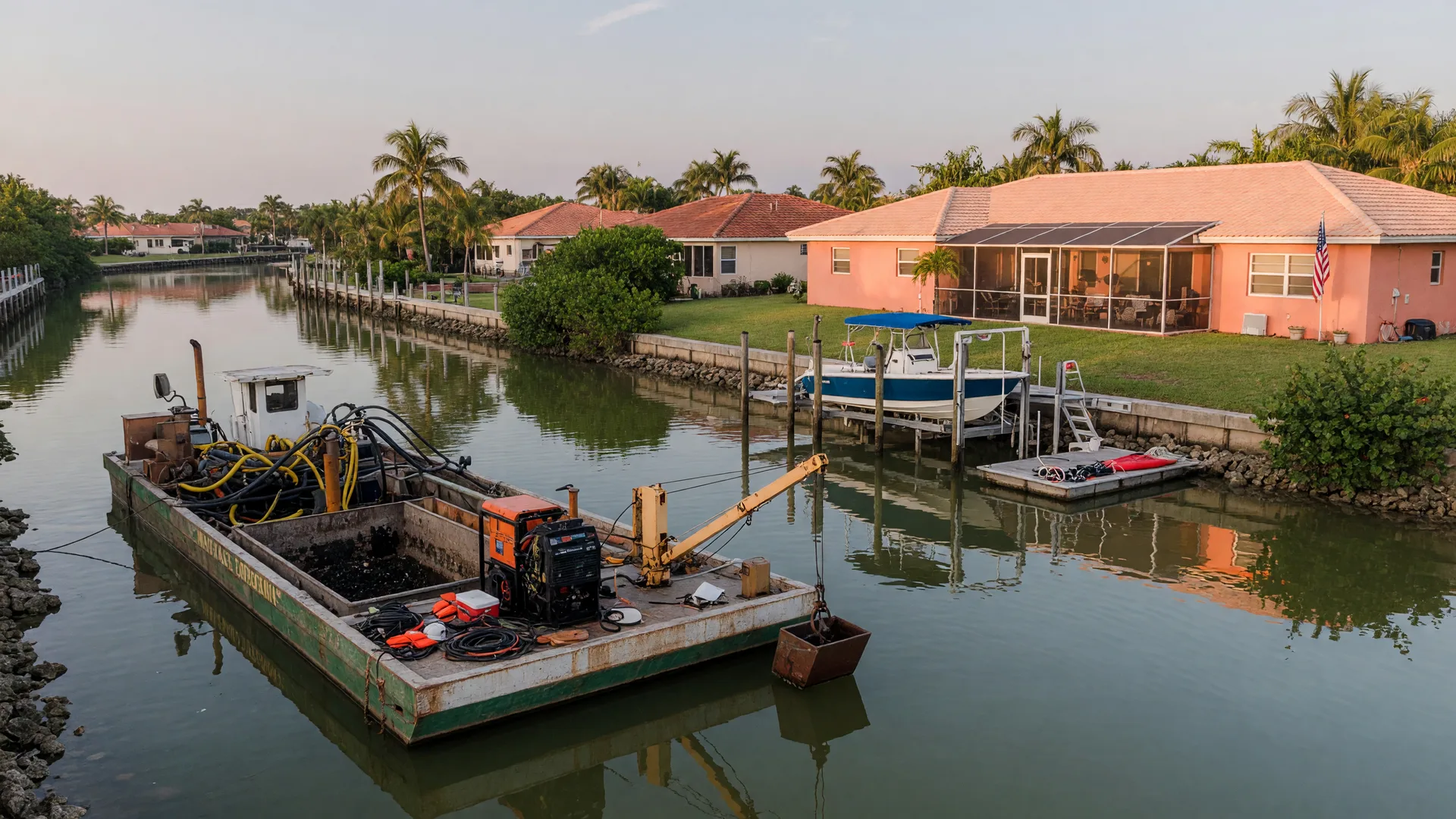
A practical checklist of questions to ask a dredging contractor before you hire one, covering licensing, permits, equipment, depth verification, disposal, scheduling, insurance, and references.
Why the questions matter
Dredging a dock, boat slip, or canal is a significant job, and the contractor you choose shapes how it goes. A waterfront property owner should know who they are hiring, how the work will be done, and what the contractor is responsible for before any work begins.
The questions below are a practical checklist. They help you confirm that the contractor is licensed, that permits are handled properly, that the equipment fits your slip, and that the job is done and documented the way it should be.
Licensing: ask what license the contractor holds
Ask what license the contractor holds and ask for the license number. In Florida, dredging falls under the Certified Marine Contractor license category, which is regulated by the Construction Industry Licensing Board.
Once you have the license number, verify it with the state. A quick check confirms the license is current and in good standing before you commit to the job.
Permits and environmental compliance: ask who handles the permits
Ask who handles the permits. Dredging in Florida state waters is regulated by the Florida Department of Environmental Protection (FDEP), and work in federal waters is regulated by the Army Corps of Engineers.
Confirm that the contractor handles the permitting and understands the environmental review process. Unpermitted dredging is a violation of Florida law and can carry serious penalties, so the contractor should never suggest skipping it. A contractor who handles the paperwork as part of the job takes that burden off you.
Equipment and access: ask what they use and whether it fits your slip
Ask what equipment the contractor uses and whether it can work around docks, pilings, and boat lifts without disturbing them. Purpose-built equipment is sized for the tight spaces of a residential waterfront, where a large machine has no room to maneuver.
Ask about the equipment's reach and whether it can access your specific slip. Every waterway is different, and a contractor should be able to tell you whether their equipment can reach your dock and work within it.
Depth verification: ask how they measure before and after
Ask how the contractor verifies the depth they achieve, and whether they measure before and after the job. Depth at mean low tide is the honest test of whether a boat clears the bottom, so the measurements should reflect real conditions.
A contractor who documents the depth before and after gives you a clear record of what the project accomplished, which is useful to keep for your own records.
Disposal and haul-away: ask how the material is removed
Ask how and where the dredged material is disposed of, and whether haul-away is included. Dredged material has to go somewhere, and proper disposal is regulated, so this matters.
A contractor who hauls away all the dredged material handles the whole job rather than leaving you to deal with what comes out of the water.
Turnaround and scheduling: ask how long the job takes
Ask how long a typical job takes and how the contractor handles conditions like tides that can affect the schedule. Tides change the working window, and a contractor who plans around them gives you a realistic timeline.
A clear expectation of the schedule helps you plan around the work, whether you use the dock daily or seasonally.
Insurance and references: ask for proof
Ask for proof of insurance and for references from recent jobs, ideally in your area. Insurance protects you if something goes wrong, and references from nearby jobs tell you how the contractor has performed for other waterfront owners.
A contractor who is willing to share both is a sign of a professional operation.
What to look for in a dredging company
Taken together, the answers to these questions point to the qualities that make a dredging job go well. Look for a contractor who is licensed, who handles the permits, who uses purpose-built equipment that fits your slip, who hauls away all the dredged material, and who communicates clearly about the schedule and the job.
Eastern Dredging is set up that way. The company is licensed and insured, handles permits, uses purpose-built equipment sized for residential docks and slips, provides complete haul-away of the dredged material, and communicates clearly about the work and the timeline.
For a free estimate, call (561) 299-1323 or email slselleck@gmail.com. Tell us about your dock, slip, or waterway and we will help you understand what it needs.
This content was created with AI assistance and reviewed for fair housing compliance.
More from News & Updates